If you have scrolled through Instagram or TikTok lately, you have almost certainly stopped to stare at a pair of impossibly perfect eyebrows. They are full, feathery, and brushed up in a way that seems to defy gravity, replacing the blocky, drawn-on look that dominated the last decade. This viral aesthetic isn’t the result of great genetics or a magical clear gel; it is the result of a treatment called brow lamination. It has quickly become one of the most requested services in salons worldwide, promising to turn even the thinnest, most stubborn brows into fluffy arches that rival supermodels.
At its simplest level, you can think of this treatment as a “keratin lash lift” but designed specifically for your eyebrows. It is a chemical process that reconstructs the brow hairs to keep them in a desired shape, usually brushing them upward to create texture. The primary goal is to hide small gaps and give the illusion of major hair growth without the pain or commitment of needles. It allows you to manipulate your natural hair to cover more skin, instantly making the brow look twice as wide as it naturally is.
However, putting chemicals near your eyes can be a little intimidating if you don’t understand what is happening. The internet is full of amazing before-and-after photos, but there is less information about the actual biology behind the transformation. In this post, we are going to demystify the science of the process. We will break down exactly how the chemistry works, what happens during the procedure, and why it has become the gold standard for modern beauty.
Decoding the Treatment: What Actually Is It?
To truly understand brow lamination, you have to understand the concept of “re-texturizing” hair fibers. Many people hear the word “perm” and immediately picture tight, frizzy curls from the 1980s, but this is actually the same chemical principle used in reverse. Instead of wrapping hair around a rod to create a curl, lamination uses chemical solutions to straighten and relax the hair so it lies flat. It removes the natural curve or “cowlick” from the hair, making it pliable enough to be swept in any direction you choose.
The treatment originated in Russia and quickly spread across Europe before becoming a staple in the United States. It was developed as a solution for people who had plenty of brow hair, but the hair grew in messy, downward directions that made the brow look droopy. By fundamentally changing the structure of the hair, estheticians realized they could “lift” the entire face. It is effectively a straightening treatment that grants you total control over hairs that used to be stubborn and unmanageable.
The Chemical Mechanism: How It Reshapes Hair
The reason your eyebrow hair stays in a specific shape—whether it is curly, straight, or sticking straight out—is due to proteins called keratin. These proteins are held together by strong chemical connections known as disulfide bonds. These bonds act like the internal skeleton of the hair, dictating its permanent shape. You can temporarily change the shape with brow gel, but as soon as you wash your face, the bonds snap the hair back to its original position. Lamination works by chemically dismantling this skeleton so it can be rebuilt in a new form.
Disulfide Bonds and the Relaxation Process
The first major step in the process involves applying a “Lifting Cream,” which is the engine behind the entire transformation. This cream typically contains an active ingredient called thioglycolic acid, which is safe for use on hair but powerful enough to do the heavy lifting. When this cream sits on your brows, it softens the outer cuticle of the hair shaft and penetrates deep into the cortex. Its job is to dissolve the disulfide bonds that hold the hair in its natural, stubborn shape.
Think of your natural brow hair as a rigid, dry twig that snaps if you try to bend it too far. The lifting cream turns that twig into a soft, flexible piece of string. During this phase, the hair becomes incredibly vulnerable and malleable. This is the moment where the magic happens, as the hair loses its “memory” of how it used to grow. It becomes a blank canvas, ready to be told exactly where to go and how to sit on your face.
The Crucial Neutralization Phase
Once the bonds are broken and the hairs are brushed into their new, fluffy vertical position, they need to be locked in place. This is where the second chemical solution, often called the “Setting Lotion” or neutralizer, comes into play. You cannot leave the bonds broken, or the hair would simply disintegrate or fall out. The setting lotion works to reform the disulfide bonds in their new alignment, essentially hardening the “string” back into a “twig,” but in the new shape.
This chemical reaction is known as oxidation, and it is crucial for the longevity of the treatment. It seals the cuticle back down, trapping moisture and nutrients inside while cementing the hair structure. Once this step is complete, the hair is chemically “fixed” in an upward direction. This means that even after you shower or sleep, the hair will naturally want to lay flat and upward, rather than curling or pointing down.
The Salon Experience: A Walkthrough of the Procedure
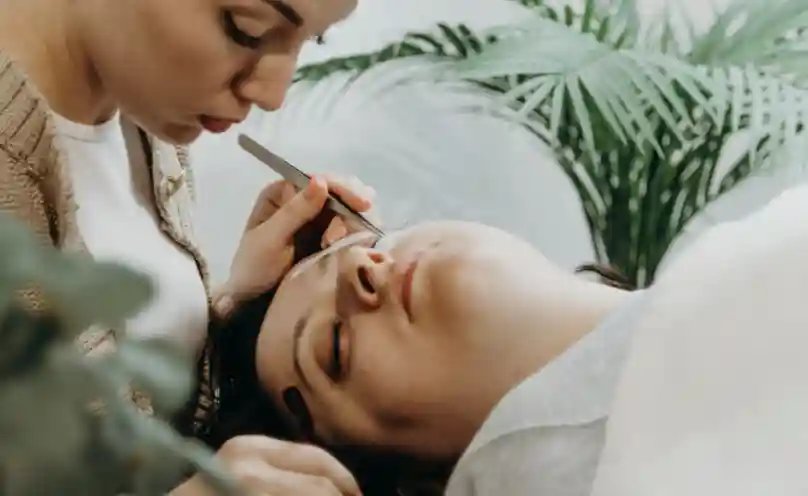
Walking into a salon for a brow lamination is a quick and generally painless experience, usually taking less than an hour. The appointment always begins with a deep cleansing of the brow area. The technician must remove every trace of makeup, skincare, and natural oils because these create a barrier. If the hair isn’t perfectly clean, the chemical solutions won’t penetrate evenly, leading to patchy results where some hairs lift and others don’t.
After cleansing, a skilled stylist will apply a barrier cream or balm to the skin surrounding the eyebrows. The skin on your eyelids and forehead is sensitive, and the lifting solutions can be irritating if they sit on the skin for too long. This protective step ensures that the chemicals only treat the hair, not your skin. Once you are prepped, the lifting solution is applied, and the brows are often covered with plastic wrap to trap heat and speed up the processing time, which usually lasts anywhere from five to twelve minutes depending on your hair thickness.
Solving Common Brow Dilemmas: Who Is It For?
One of the reasons this service has remained popular is its versatility in solving very different types of brow problems. It is not just for one specific type of client; it addresses issues at both ends of the spectrum. Whether you have too much hair that is out of control, or too little hair that disappears on your face, the mechanics of lamination offer a solution.
Taming Coarse and Unruly Textures
For clients with coarse, thick, or curly brow hairs, the daily struggle is trying to get them to lay flat. These hairs often grow straight out from the face or in wild, downward spirals that make the eyes look heavy. Brow lamination is a game-changer for this hair type because it acts as a relaxer. By smoothing the texture, the hairs lay flush against the skin, looking neat and uniform without the need for heavy, glue-like gels. It turns a messy, unkempt brow into a sleek, high-fashion feature.
Creating the Illusion of Fullness for Sparse Brows
On the other hand, clients with thin, sparse, or over-plucked brows benefit from the “combover” effect of the treatment. When brow hairs lie naturally, they might overlap or curl, exposing the skin underneath and creating visible gaps. By lifting these hairs vertically and flattening them, each individual hair covers more surface area. It allows the stylist to brush hairs over bald spots, effectively hiding gaps and making the brow look significantly denser. It maximizes every single hair you have, making it a great alternative for those who aren’t ready for permanent makeup.
Customizing the Look: It’s Not Just “Stick Straight”
A common fear is that lamination will leave you looking like a “scared cat” with brows that stick straight up in an unnatural way. While that intense, spiky look is often photographed for high-fashion magazines, it is not the only option. The beauty of the treatment is that the hair is malleable, not frozen. You have complete control over how you style them on a daily basis.
Conclusion
In summary, brow lamination is a sophisticated chemical process that breaks down and rebuilds the structure of your hair to create a fuller, more uniform aesthetic. It leverages the science of disulfide bonds to correct growth patterns, tame unruly texture, and hide gaps, offering a powerful alternative to invasive procedures. It is a temporary, adjustable, and highly effective way to enhance your natural beauty.
If you are tired of fighting with your eyebrows every morning, this treatment offers a reprieve that lasts for weeks. However, because it involves chemicals, the skill of your artist matters just as much as the product they use. Do your research, find a reputable salon, and prepare to be amazed at how much potential was hiding in your natural brows all along. With the right care, you might just find it’s the one beauty appointment you can’t live without.